There is no shortage of confusion and misinformation when it comes to wagyu (see our Myths & Facts blog post for more on the topic). Adding to this confusion is that wagyu is sometimes distinguished by its country of origin, with Japan, Australia and US being the largest producers of wagyu.
But does country of origin even matter? Or, since Japan is the origin of wagyu, is there any difference in quality between wagyu from the US or Australia?
Yes and yes, and here’s why: Anyone buying beef in the US should be skeptical about the authenticity of any beef labeled as wagyu. Which is “best” is a matter of preference, but what follows is our attempt to set the record straight on the differences, so that you can understand them and pick the best steak for you.
What's the Difference Between Japanese, Australian, and American Wagyu?
Japanese Wagyu
Japanese Wagyu is obviously the real deal. If you’re a US consumer and you come across wagyu that you can be certain was imported from Japan, it’s safe to say that you’re looking at 100% Full Blood wagyu.
Technically there are other cattle breeds of Japanese wagyu that don’t have the distinctive marbling we’ve all come to know and love. That trait is exclusive to the Kuroge Washu breed (see more about the different breeds here). Kuroge Washu A5 is generally the only kind of wagyu that’s imported to the US market, which is why “Japanese Wagyu” is a safe proxy for the most authentic wagyu you can buy.
American Wagyu
U.S. labeling law in general does not enforce a percentage of wagyu parentage threshold for products marketed as “Wagyu," which means American wagyu can mean genuinely excellent beef or a poor imitation of the real thing.
Why invest in higher quality if you can’t distinguish yourself and charge more for it? This doesn't mean there are no fullblood wagyu producers in the US, but they’re few and far between. Unfortunately, the lack of standards in the US beef market means that you can’t be sure of the quality you’re getting when you buy American wagyu.
Australian Wagyu
So what about Australian Wagyu? It falls in between the two, leaning a little towards the higher quality, Japanese end of the spectrum (see info graphic). The Australian market has more specific definitions to call attention to and inform consumers how authentic their wagyu is. Whereas the United States doesn't have a genuine minimum threshold, Australia sets its minimum at 50%, followed by a tiered grading system that extends all the way up to 100% fullblood (which would be any wagyu cattle with two fullblood parents).
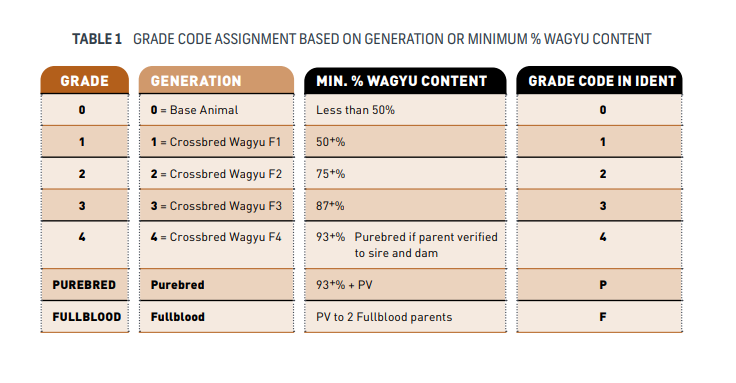
Source: https://www.wagyu.org.au/for-members/fullblood-and-commercial-breeding
How Is Wagyu Beef Graded?
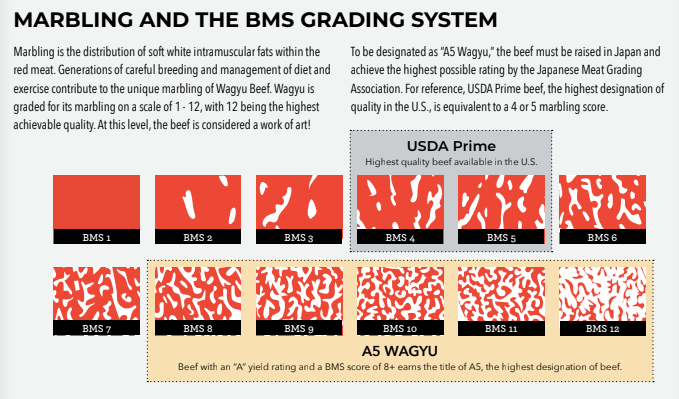
Japan and Australia grade beef on a 12-point Body Marbling Score (BMS) Scale, while the US, through the USDA, uses a much simpler scale that has three retail grades: Select, Choice and Prime. (There are several lower tier grades but they're primarily used for canned meat and processed foods). The problem is that USDA Prime, the highest tier, begins at what would be considered a low-to-medium tier on the BMS Scale in Australia and Japan (see infographic below).
Generally speaking, this means American wagyu—even the best America has to offer—can't compete on the same playing field as its Japanese and Australian counterparts, if only because the way fat content, which is often used as a proxy for quality, is judged in wildly different ways. Imagine if you could only set the volume of your headphones to high-, medium-, and low-volume rather than the wide range you're used to. That's the USDA grading system versus the Japanese and Australian BMS Scale.
What's the Best Wagyu for You?
In a world of confusing and misleading marketing terms (especially in the US market), specifying the country of origin for wagyu is a very useful clue as to the quality and authenticity of the beef that’s under the label.
While Japan holds the title of being the most authentic and highest quality (most marbled), it has a price point to match. American wagyu is all over the place in terms of quality, but offers a lower entry level price point. Australian wagyu meanwhile strikes a nice balance between the two.
Which is “best” is your call, and you may even prefer different countries for different cuts and different occasions. We might recommend an A5 Wagyu Striploin for a fancy special occasion, but an American Wagyu brisket or Tri Tip if we were in the mood to use a smoker or grill on the 4th of July.